Strategic Route Navigation: How Professional Car Service from JFK and Baltimore Beats I-95 Traffic Bottlenecks

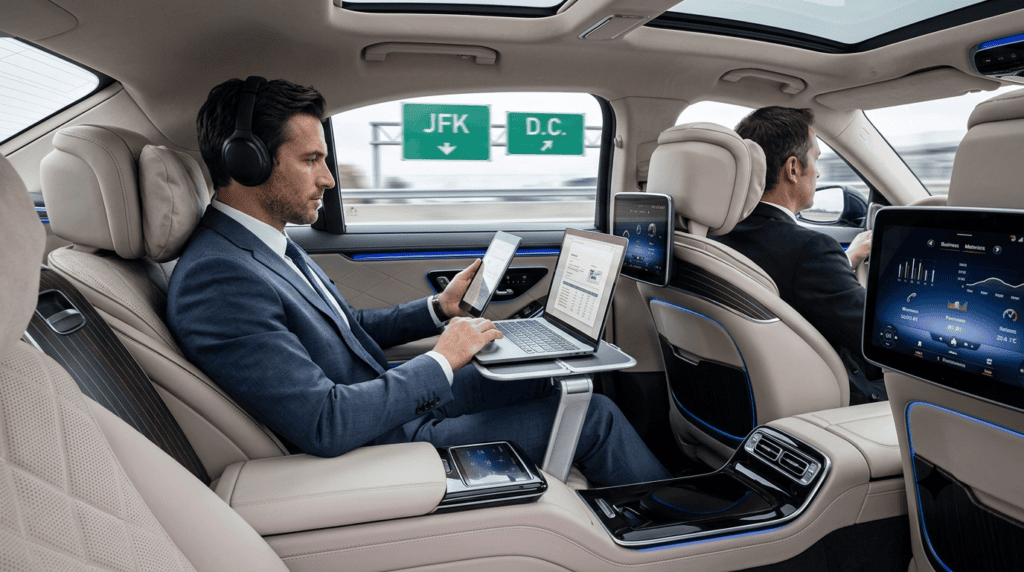
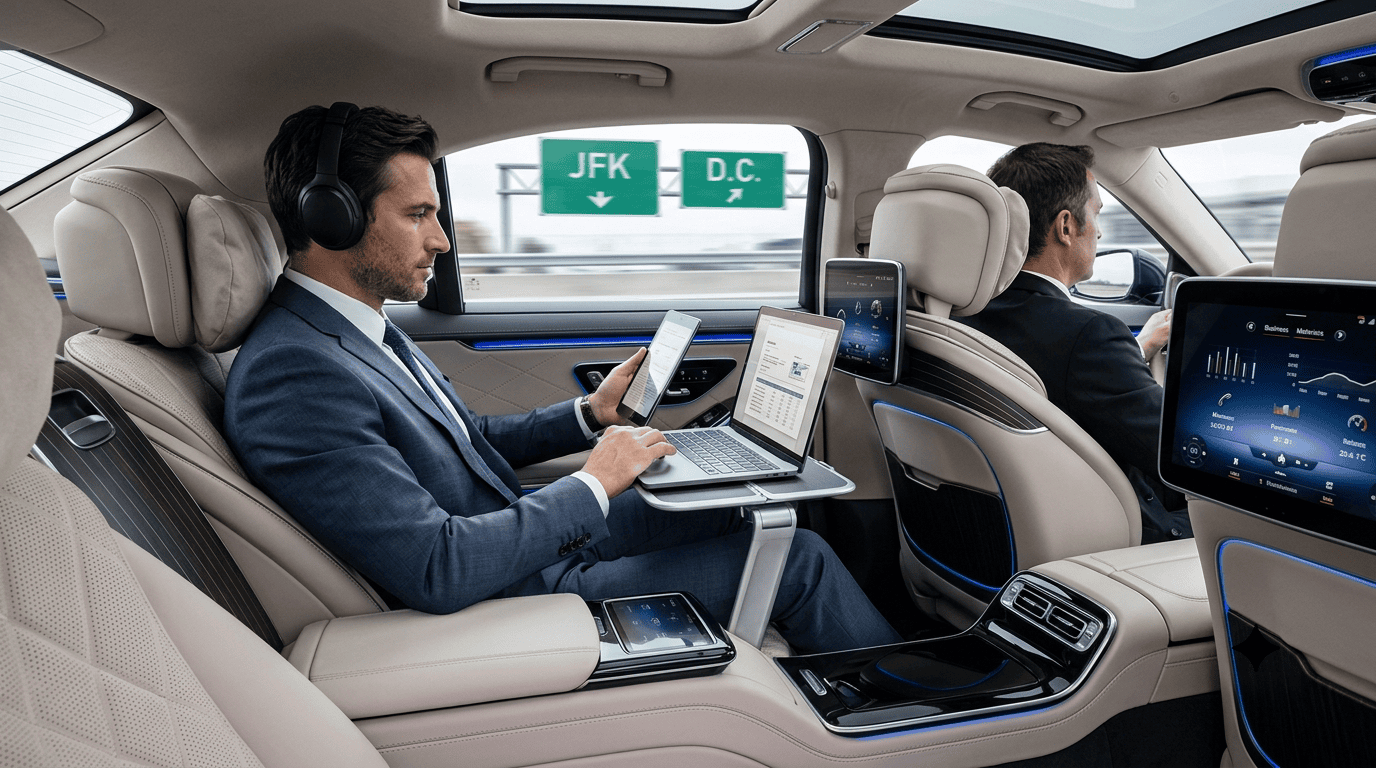
Executive Car Service from JFK to D.C. Turn Transit into 4 Billable Hours

Table of contents
33mn read

While leaving JFK Airport and heading towards Baltimore, the passengers checked their phones. The map has the blue lines and shows that the trip requires ninety-four minutes. After 40 minutes in the Kew Gardens Interchange, the map shows the red line, and the time increases by 25 minutes.

The traffic does not increase immediately; the passengers face the traffic—the app only tells you about a problem that professional drivers and dispatch already know: at this particular time of day, the traffic is slow and bad.

It’s not about you defeating the traffic—on rush roads and bridges like eight-lane tunnels where 115,000 cars are on the road, the heavy traffic cannot finish immediately; only knowledge about routes doesn’t make them thin to wide. The difference is about being stuck on the road and planning before you arrive.

This difference can be more important if the passengers are travelling between JFK and the Baltimore-Washington area and JFK and other areas along I-95—from this, your meeting time can be delayed, and you arrive late.

And with the passage of time, these delays cause a lot of cost and time that many people don’t notice. Here is what that extra cost and planning time creates.

The corridor problem named specifically:


Traffic is not everywhere on I-95—traffic conditions are bad at specific locations, like in rush hour roads where there is very little space, before planning a trip. Always have knowledge about these routes to improve your trip.

On the JFK road, the areas that have problems are the Van Wyck Expressway (I-678), which is a highway that has six lanes and links the JFK airport to New York. It was made in the 1950s when there were very few cars on the road.

But now there are about 170,000 cars every day on the road that pass along the JFK-to-Kew Gardens route, yet this route only has six wide lanes.

According to New York State, this route is blocked for many hours a day—the Kew Garden Interchange is one more problem in this area. The Van Wyck links with the Grand Central Parkway, the Jackie Robinson Parkway, or the Union Turnpike.

So, many drivers don’t take direct trunks without passing from the streets and moving off the highway.

To make this area expand, there has been a large project for many years and a part of a bigger project to improve the JFK airport. This project and plan require lots of unlimited and uncontrolled traffic on the roads that cannot be managed easily.

And these hurdles and roadblocks are already known to many people, and work continues through construction.

These places cause many traffic problems on the I-95 highway that is between New York and Baltimore. The Jersey Turnpike from Newark and northeast New Jersey has the problem of trucks and extra vehicles.

Traffic on I-95 and I-78 is linked on the same route because there are more cars than roads, causing delays and late arrivals.

The Delaware Memorial Bridge in Delaware connects the New Jersey Turnpike to I-95/I-295. On the East Coast, it is one of the most trafficked bridges for trucks. This bridge is included in the construction projects that are starting on 7 September 2026. By working on the New Jersey-bound side, they will remain closed to the most used lanes all day.

And they make another lane for the cars. And the plan will continue till the 24 November 2026 before Thanksgiving. Due to a restricted schedule the construction continues till the holidays if in any case the work delays.

It’s not a future problem; it’s a present problem that passengers have to be aware of and make a proper plan about.

Eight lanes of the tunnel are the Fort McHenry; it is 1.4 miles and has the I-95 in Baltimore’s Inner Harbor, and every day there are about 115,000 cars. The reason is that this tunnel has constant lanes, not expanded like a highway.

In busy times there is lots of traffic on I-95—near the tunnel. To improve the traffic sequences, Maryland is working on the project by adding the express toll lanes. In the Port Covington area, for improving the I-95 area nearby the tunnel, here the work continues.

The problems are also present at the Baltimore Beltway (I-695)—due to traffic from many areas like here, and this causes the travel time to be unstable. These traffic problems are not normal; these bridges, roads, and tunnels have very little space, which can happen easily at the same place.

It means the driver and car are are planning the route according to it.

That is why knowing about traffic problems is critical—if traffic is normal, then planning is not worthwhile. But when problems occur, then good planning works here and is worth it. And you can get rid of many problems.

While travelling from downtown Baltimore to downtown New York, Baltimore has a better, fast train option. So JFK doesn’t have any continuous train option, and Baltimore has this option. The business passengers can take the train if their trip starts and ends at the station.

But many of the trips are not like that —- and these two corridors are not too different; there are many things that are the same in them.


What the national data says about the stakes


By looking at the real numbers only, saying that “traffic is worst” is not like saying that it is bad; you also need to know how to plan your trip. By INRIX’s 2025 Global Traffic Scorecard, the U.S driver in 2025 at high traffic lost the time of 49 hours.

And in 2024 this is an 11% increase—the time in which drivers are stuck costs about $894 to one driver. This is more than a work week in traffic.

According to INRIX, they predict that the time that is lost in traffic will cost about $85.8 billion. The cities that are present on these routes have much more bad traffic than their estimation.

In 2025 the New York drivers lost about 102 hours, and these hours cost them $1,879 for one driver. Philadelphia crossed the I-95 in between New York and Baltimore, and they lost their 101 hours, and then it was on the list of most traffic-congested cities.

Baltimore has fewer lost hours, about 63 hours—but its traffic will increase in 2024 till 2025 by 31%, and this percentage is the largest in the top 25 US cities.

These all show that traffic problems are not just uneasiness; they cost a huge amount of money and waste time—so that is why planning on time is critical.

INRIX’s 2025 — According to them, the biggest traffic area is Stamford, Connecticut, in the U.S.; because of traffic, the drivers lose 133 hours every year. And this is the worst traffic across the country.

It’s the same as the I-95 highway, only a different part of it. The I-95 not only has the traffic problems in the one small region, but most of the parts include the fully busy roads of commuters in the U.S.

The point is not that private cars eliminate the traffic — it’s about how much the traffic problems are big for decreasing the delays. The passengers who travel between JFK and Baltimore daily don’t face these problems a lot.

They are passing from the busy corridors — and bridge construction is continuing and roads nearby of JFK that contain traffic.

The new framework: the congestion tax


The congestion tax means that the cost of traffic and passengers has to face traffic problems if their plan is based only on one route. If traffic conditions are normal, then passengers still need to plan their route. The reason is that there is no other route option.

This point is different from preferring the good transportation —- the model of Total Trip Cost Model measures the travel methods of taxi, rideshares and train. But on the other hand, the congestion tax is different and tells about how a good vehicle option handles your traffic problems.

If there is no good train transportation option, then the private car is the best option here, but still you can lose your time if the driver and car company have only one route planned.
The point is — having the right type of transportation is a problem solver. And if you also plan the corridor in full, it will reduce traffic problems and extra costs.

The congestion tax has four main points—each with a different cost and time.

  1. Fixed-route padding—it’s an additional time that passengers add to their timetable because they are worried about the traffic delays on I-95. If their trip is only 2 hours, they depart 3 hours early to avoid traffic—and if there is no traffic, their time is wasted.
  2. Chokepoint exposure—it’s a time that was spent in traffic problems at 5 pm at the Van Wyck in busy times, near the Fort McHenry Tunnel near the Baltimore backup. If you have only one route option and then traffic gets bad, then you are waiting a lot because of delays.
  3. Missed-window cost—and it’s a condition where travelers miss their meeting because of traffic, like they miss their flight and are late/miss their meeting because they want to take an important office call. And if you miss an important meeting, then these delays cost you a lot.
  4. Reroute-blindness cost—it’s about when you are fully stuck and blocked on the route, and you don’t have any idea of another route, and it costs you. Like—before leaving and choosing different routes, drivers check traffic near the Delaware Memorial Bridge. The dispatcher saw the problem and adjusted the departure time. They don’t wait for the traffic; they normally decrease the delays rather than waiting after the delay.

It’s necessary to mention what the congestion tax does not say—experienced drivers cannot eliminate traffic; they use new routes and shortcuts that other drivers don’t find.

Many drivers use the exact traffic information on the I-95 route by adding GPS apps, traffic reports, road cameras, and Waze and Google Maps. The main benefit is in planning the route on time — the drivers use this data beforehand, and then, when needed, they change it according to the traffic.

And this decreased the passengers’ time that they spend in traffic. And these are all not making traffic finished—after that, roads still have the restricted space. There are many forms of transportation that are used.

The single driver doesn’t eliminate the traffic on routes—it’s about making a good plan before and after the trip starts.

Why a phone app and a professional driver aren’t doing the same job


This is an important point to note that the reason is it looks like marketing — the point is not that the professional drivers have the special kind of information then the regular drivers. Any kind of driver knows about the route’s information; it’s easy to see the traffic conditions by using the apps Waze or Google Maps.

These apps also recommend the routes if traffic problems occur — so this info is available for everyone.

The point is how drivers use the information—before the trip the professional driver checks the routes and identifies the main problems in the routes and then plans accordingly on time. And during the trip they keep monitoring the route’s conditions, and if any changes require it, they change it.

The benefit is not having the information about routes — it’s about focusing on the route and making plans before any problem that causes delays.

There are three main things — in which the difference is normal: then the information.

First, undivided attention to the road and data at the same time—a passenger passing from the kew garden interchange notice on the road and also see their phone for the route’s directions. So it’s hard because the Kew Interchange is very busy and full of traffic. And an experienced driver drives and also monitors the information without dividing any focus.

Second, the ability to adjust before committing to a checkpoint rather than after —- before your trip starts, the driver checks the route’s conditions, and before departing from JFK, they check the Baltimore Memorial Bridge. If any lane is closed or there is lots of traffic, they change the time of leaving to 30 minutes and changing another route—and before the trip they tell the passengers about the delayed route.

The main advantage is not the travel information —- it’s about the focusing on the travel and if you get stuck they can change the route.

Phase 1: Pre-Departure Check (T-20 to T-15 Minutes)


Before you start the trip, you complete these checks:

  1. Verify Primary Route Status — Put the initial points and your main location into the navigation system. See the red lines on the map that show the traffic areas and construction places and other alarms.
  2. Check Key Bottlenecks & Critical Crossings — keep monitoring the traffic places in the routes like bridges and tunnels and Kew Gardens interchanges. If bad weather and accidents occur, then keep checking the cameras of traffic and other transportation departments’ news.
  3. Determine Threshold for Alternative Routes —- if one route shows the 15 minutes of delays then choose another route. And fully know that the other route should be good and not have any kind of limitations in the car about weight or height.

Phase 2: Action and Communication Protocol (T-10 Minutes)


Scenario Identified
Operational Action Required
Passenger Communication
Clear Route
Proceed with primary route plan.
tell passenger on ETA and planned route during greeting.
Minor Delay (<15 min)
Stick to primary route; monitor live audio traffic alerts.
Inform passenger of slight delay and tells how it is manage
Major Delay (>15 min)
Switch to secondary pre-planned alternate route.
Present alternate route choice and adjusted ETA before vehicle moves.

When you find out that this is the traffic problem, then decide before departure, and this involves the time of leaving, changing the route, and information the driver has about routes and delays.

Phase 3: Cockpit Setup (T-2 Minutes)

 
  • Set navigation audio: set this tune light, not too much that it causes distractions.
  • Secure devices: Make sure that your activating devices are near and easily found by the driver without bending.
  • Hands-free rule: While the car is moving, don’t use the navigator—when the car is safely stopped, then route changing occurs and is managed by a dispatcher.

Third Corridor familiarity with the compound in a way one off GPA session doesn’t —- a driver who is daily traveling from the JFK to Baltimore he knows about the problems that can happen during the trip they have knowledge about the areas that are busy —- Van Wyck and the accident on beltway that is for short time and finished in about 40 minutes but the construction problems take time till the november.

So, this familiarity with the routes helps drivers to take action—normal traffic conditions can be easily overcome by changing the time. And in a short time accidents may be wiped out immediately.

So taking another route can be better.

If you have the rented car and rideshare, then you don’t have the idea about the route’s condition. Therefore, if the driver of the rideshare also doesn’t have family with the routes and traffic problems. The point is not about knowing the mysterious routes—it’s about having proper knowledge about routes that take action on the traffic problem.

There is not any point that businesses have special kinds of traffic tracking systems—that is different from the common apps. If a business contains the dispatcher who monitors the route and checks the route before the trip and data use that helps the drivers to have a good route—so these all make this point valuable. But after confirmation.

If these are not available at that time, then it’s simple to understand this point by doing focus, planning on time, and having knowledge about routes. These are not from mysterious traffic knowledge.

Quantifying the congestion tax


Using numbers can make your point weaker or stronger—so it’s necessary to discuss which point is verified and which is only predicted.

What makes sense is the traffic data of these routes—Philadelphia’s and Baltimore’s increase in bottlenecks by about 31% from one year to the next is not an estimation. These are real data from INRIX for 2025. The tunnel of Fort McHenry—each day it has 115,000 cars. And the Van Wyck, on its six-lane road, has 170,000 cars a day.

And all of these come from the DOT and MDTA.

The Delaware Memorial Bridge’s plan about lane closure from September 7 to November 24, 2026, is based on real information from the public from the Delaware River and Bay Authority, which is not a prediction.

The proper measurements about this route are based on time on the route and time you actually hope for.

Dispatched vs. Budgeted Trip Data


Morning Peak (6:30 AM–9:00 AM) from the JFK

  • The whole trip time is about — 4 hours 15 minutes.
  • And the travel budget time is of — 5 hours 15 minutes.
  • Extra/additional time is — 60 minutes.

Early Afternoon (10:00 AM–1:00 PM)

  • The whole trip takes about – 3 hours and 45 minutes.
  • Travel budget time is about – 4 hours and 45 minutes.
  • Extra/additional time—60 minutes.

Evening Peak (3:30 PM–6:30 PM)

  • The whole trip takes time—about 4 hours and 45 minutes.
  • Total travel budget time—6 hours.
  • Extra/additional time—75 minutes.

The 200-mile travel from JFK to Baltimore—the whole trip takes 3 hours 45 minutes during the intermediate part of the day. And in the morning it requires about 4 hours 15 minutes, and during evening traffic it requires 4 hours 45 minutes.

Because of the traffic chances at the I-95 and construction work, the travelers plan their trip for 4 hours 45 minutes to 6 hours. So the 60 to 75 minutes are added to the travel as an extra time. So this extra time is of the congestion tax observable.

If there is no internal data, then this is just an example because of public information. Think about if a passenger arrives at the JFK for the 2:00 p.m meeting in downtown Baltimore, and 195-210 of miles of distance.

In normal traffic, it takes about 3 hours 45 minutes to 4 hours 30 minutes.

And the direct travel time —- a private car takes about 200-mile from JFK to Baltimore and requires a time of 3.5 to 4 hours in normal traffic.

Due to continuous bridge construction — and its decrease about November 2026 and daily crowd at JFK — a one traveler adds the 45 minutes to 1 hour in the normal time for delays to for the delays at the van wyck bridge.

And all these are the congestion tax—the passengers in the morning and in the evening waiting at the hotel before time—if there is no need for extra time.

Previously use the broad room continuity index —– the wasted hours don’t mean it just and extra time a passenger who make their trip time and have a meeting at 2 p.m if one hours is just spending in waiting and this extra time means that less time for their preparations and making calls or normally reach smoothly rather than the rush.

Executive Cost-Impact Models: Executive Tier (C-Suite / Senior Partner)


Billable/Value Rate: $500/hour—$500 per hour

  • Extra lost time—1 hour of unproductive waiting
  • Cost per Trip — $500
  • Yearly Impact—have 12 trips and cost about $6,000

Senior Management Tier (VP / Director)


Time value—$250 per hour

  • Extra lost time—1 hour of unproductive waiting
  • Cost per Trip — $250
  • Yearly Impact: 12 trips—and a cost of $3,000

High-Value Deal/Project


Predicted Value of Time—$1,000 per hour

  • Extra lost time—1.25 hours (75-minute forced buffer)
  • Cost per Trip—$1,250

While using the Boardroom Continuity Index, this extra time has a real cost for business executives whose time is valued at about $500 an hour, and if they wait in the hotel lobby for 60 extra minutes, it means they lost their $500 time in work and their preparations for one trip. If every year travelers make the 20 trips, then lost time costs about $10,000, and their productivity is fully lost.

The point is if drivers know about the routes and make a good plan on time, it decreases the extra time, and from it they have more good predictions and help them to avoid the difficult routes when another corridor is available. They can’t eliminate the extra time.

Much of the extra time is the cost of your travel en route, and according to the INRIX data, every year it becomes harder.

The infrastructure context is why this corridor isn’t getting easier soon


It’s important to look at this route —- the traffic condition and what can occur in the future—and it helps you understand why the congestion tax had a bad effect on the passengers for many years.

The Delaware Memorial Bridge is under a construction project and continues till November 2026. The Delaware River and Bay Authority tells us that this is just the first part of two phase project; a decrease in the lane is not only a short-term problem—they are part of a huge construction project on the rush brigades of the trucks and cars on the east coast.

It’s also a chance that this work can take much more time than planned—the date of completing this project is November 24, 2026, and that is on Thanksgiving. And if it is delayed, then the construction may continue during one of the busiest travel periods of the year, and it causes more traffic and delays.

In Maryland, the Fort McHenry Tunnel has two big construction projects that have been bad for traffic for many years. On the north side, Maryland also works on the toll lanes for handling the daily rush hours in Baltimore and Harford. And this project involves managing the daily accidents and route problems.

In the Port Covington and I-95 on the south tunnel side —- this project is continued towards the end of the many years. It means the areas in the Baltimore and harbor lines have construction projects that are continuing for years—not for several months.

The JFK—Van Wyck Expressway is widened —- the project here has the fourth and fifth lanes at the Kew Gardens Interchange and JFK Airport. This project also has the construction of nine bridges.

And its huge amount of hard work—at the JFK side—and this all cost about $13 billion.

So, these projects have required many years to finish this, and traffic conditions at that time at JFK were high. It means the road already has a lot of traffic before the construction traffic is counted.

Not anyone’s point is about to scare you—it adds because it changes the main purpose of the dispute. If these problems are just for a short time, then it’s a suggestion to wait when the routes are not improved and then begin your travel—so this is not in the route; these all are routes, like Van Wyck, the Delaware Memorial Bridge, and the Fort McHenry Tunnel, are included in the major construction project that remains continuous for many years.

And some of them are for decades. And for those who travel on this route, keep in mind that this is not a minor uneasiness —- you should expect traffic to keep changing because construction will continue for many years.

Traffic was already a bad problem before construction works—that’s what INRIX estimated. So you need to plan differently rather than just hoping for a regular bad traffic day. And that is the reason he talks about the congestion tax.

Three Layers of Accountability Applied to Incident Response


This point tells about the driver plan, dispatch monitoring, and company works; these all make the passenger experience excellent. In traffic and incidents, these are the three layers:

Layer One—The Driver’s Real-Time Judgment

This is a very common one that is used on every trip here. Drivers have knowledge about the quotes, use the navigation tools, and take action when driving —- like when traffic changes, then the driver also changes the route lane.

So this layer is used in every trip where the driver is accountable for taking action in driving instead of just depending on the app.

Layer two—Dispatch-Level Monitoring

This point is about the dispatch system, and how they monitor the route conditions, looking at the traffic—here the purpose of the company is to keep checking the roads’ problems and traffic and delays before the driver does anything, and after that they tell the driver about particular route management.

Layer Two in Practice: Active Monitoring vs. Driver Autonomy—To check the trip performance at the JFK route to Philadelphia, focus on the two conditions:

Scenario A: Dispatch Is Actively Monitoring

Here is an accident on the New Jersey Turnpike, and the traffic is stuck for 45 minutes—and traffic is blocked for 15 miles in the car.

Active monitoring—from this, the dispatch keeps tracking the traffic by using the system and information; they see the traffic problem before the drive reaches here.

Mid-trip guidance—Dispatch also provides some guidance to the driver about routes, like “There is an accident at Exit 7A. Take I-295 South instead.”

Conclusion—and then the driver avoids the traffic problems and keeps checking the problem by themselves.

So, if the company has that type of trusted source of tracking, then the passengers’ experience is excellent, and their time is also saved.

Scenario B: The Driver Handles Navigation Alone

In this, dispatch doesn’t manage the traffic driver all alone.

The driver handles it—here the driver manages all the dispatch and monitoring from passenger pickup to arrival.
The driver adjusts the route —- by using the Waze or Google Maps driver manages the route with knowledge and then looks at the traffic and then takes action.

Conclusion—the experienced driver can get rid of traffic, but the whole process is controlled by a driver, and the traffic problems are managed by them.

Layer two is not working if dispatch doesn’t monitor the route when the trip begins, and then the driver’s own knowledge helps to change the routes, and then the correct point is of Layer one.

Layer three—Company-Level Pattern Recognition

Here there is less surety about the company records or the traffic issues that occur again and again or making it to improve in the future.

Is the company noticing the particular parts of routes’ daily delays, and after that, by using this knowledge, choosing better routes for future trips and suggesting leaving earlier at particular times?

And this is one of the useful layers where companies learn from their previous trips and then make improvements in their further trips. Rather, they begin everything from the start.

Data-Driven Scheduling—Companies do more than only use navigation at the JFK road; they see the old methods of trips. For instance, if on Friday afternoon there is a lot of traffic on the Van Wyck Expressway, they suggest their passengers make plans about their trips before the pickup so they arrive on time.

The honest concession section


Each section here truly explains that where the other option matters more, where the point has restrictions, this is important because it is easy to expand how much the route you take actually matters.

No professional service can eliminate I-95 congestion — in the worst traffic days when the accident and a snow problems so every car on this route having a professional driver or not they l pass from the same phase of blockage — A driver’s planning and timing can decree the delays on a bad day, but it does not make the Fort McHenry Tunnel have more than 115,000 cars in eight lanes, and before the November 2026 it cannot reopen the two lanes of the Delaware Memorial Bridge.

A motivated, well-prepared traveler can achieve many of the same results themselves —- many of the drivers check the traffic conditions before the trip begins, and the more time and use of the navigation system that are used by professional chauffeurs are not helpless in the road problems. The real benefit of a car in this is to avoid the extra hassles of work—not providing the information that DIY passengers do not have.

This is very different from saying, “We have knowledge about those things that you don’t.” Rather, then, this is the claim that the point is actually ready to support.

Rideshares are less costly, and here the focus is on the route, not making the price the same. They use the data like others, and they know the areas very well. In the rideshares, the drivers are chosen randomly, but in the private car, professional, experienced drivers are chosen and give trips according to their route knowledge.

So the rideshares are a less costly option for this route.

Client segments framing


Most of the passengers are badly affected by the congestion tax. It is not the same in every condition.

  • Executive and business travelers with strict time limits—these passengers have a tight timetable, and they have a meeting and court entrance, so if they arrive late, they lose their opportunity—so this is very different from the passengers who reach 45 minutes late.

For business passengers, being late can create serious results. This point is closely related to the Boardroom Continuity Index.

  • Airport connections connect travelers with tight schedules—these passengers use the JFK as their main part of the trip when they arrive at the JFK airport; after that, they have the flight, take the train, and then pick it up in Baltimore according to the timetable—their problem is also the same because they have a limited timetable and they can’t wait.

Feature / Focus
“Door-to-Door Efficiency” (Piece A)
“Routing-Execution & Congestion Tax” (Piece B)
main benefits
Total travel time and mode efficiency
Reliability, buffer control, and risk mitigation
main Audience Focus
Travelers comparing transit options (Car vs. Train vs. Air)
Travelers arrive at the cannot delyas aford
Key point / Argument
total door-to-door transit time
Cost of delay / problem caused by delyas and missing the imporant meeting
service offers
Broad mode comparison across the entire corridor
based on traffic condtions make route changes

What Corridor Familiarity Looks Like in Practice


By using the route daily then the corridor knowledge occurs — some travelers passing from the JFK to Baltimore by daily traveling they learn many things that one time person dont know.

They have the idea about points that before traffic gets heavy at the Van Wyck—when to depart from JFK. They also have knowledge about the traffic conditions at the Kew Gardens interchange, so here the normal traffic waiting is not worth it.

Furthermore, they also know about when the immediate traffic slows down at the New Jersey Turnpike that causes the accidents and problems.

In the second half of 2026, that the assumption about Delaware Memorial Bridge They know that Delaware Memorial Bridge takes longer time to cross now than it did last year because two lanes are closed until late November. They also know about where the bridge is close, like the lane close at the New Jersey-bound side of the Delaware Memorial Bridge.

If you rented a car — for one trip, they don’t have any idea about this and elys is only shown by navigation app when they’re near to the bridge not before departing from the JFK.

But this is all information they plan before the trip begins—rather than after trip problems.

There is a difference between the experienced car service and rideshares —- the professional ones link you with those drivers who travel daily on this route, but in the rideshare you have any driver who doesn’t have proper knowledge about the route or drives for the first time only through the app lanes.

So you don’t have an idea which driver you have, the experienced car service provides you dependable and good service for every route you travel —- it’s not about technology; it’s about the knowledge and experience of driving with the routes.

Comparing Travel Options: Acela vs. Regular Drive vs. Private Car Service


To check whether the private car option is valuable for 200 miles of trip, look at the total travel time from JFK to the final location and how much a passenger can work.

Amtrak Acela—The Hidden Extra Time:

Transportation Mode
Total Time
Transit Stage Details / Segments
Productivity Impact
AMTRAK ACELA EXPRESS
~4 Hours, 15 Minutes
• Terminal Deplane: 30 min• JFK → Penn Station: 55 min• Station Wait/Board: 25 min• Rail Time (Acela): 145 min• Taxi Queue at BAL: 15 min• Penn → Final Dest: 20 min
Fragmented Productivity:Short 20–30 minute segments make deep work impossible.
STANDARD RIDESHARE / SELF-DRIVE
~4 Hours, 30 Minutes
• In-Transit Driving Time: 255 min (Staggered by Bottlenecks: Van Wyck, DE Bridge, Tunnels)• Parking / Drop-off: 15 min
Zero Productivity:Driver focus required; Rideshare lacks workspace amenities.
STRATEGIC PRIVATE CAR SERVICE
~3 Hours, 15 Minutes
• Uninterrupted Mobile Office Transit: 195 min (Dynamic Bypass Routing: Rockaway / Outerbridge / US-301)
100% Continuous Productivity:Secure Wi-Fi, power, privacy, zero transfers.

From new york penn sation to the baltimore penn sation the acela requires about 2 hours and 25 minutes but here the passengers are start at the JFK not from the penn sation.

  1. Moving from JFK to Penn Station requires about 75–90 minutes for baggage, AirTrain, LIRR, or taxi.
  2. Waiting at the station—20–30 minutes for boarding.
  3. The train ride takes time of —- About 145 minutes.
  4. Getting from the Baltimore station to the final location takes time—30–45 minutes.
  5. Total travel time is about 4.5–5 hours.
  6. Work time loss—the passengers’ focus drops off after every 30–45 minutes—because the traveler must stop for transfers, luggage, security, and boarding.

Standard Drive or Rideshare

A normal car is direct; it picks you up from the airport and drops you at the final location.

  1. Pickup from JFK—Almost no extra transfer time.
  2. Driving takes about 4–5 hours, depending on traffic.
  3. Traffic can slow down the trip on roads like the Van Wyck Expressway, Staten Island
    Expressway, Delaware Memorial Bridge, and I-95, and here the time is about 240–300 minutes.
  4. Drop at the final location—directly at the destination.
  5. Total travel time is about 4–5 hours.
  6. Total productive work time loss—you cannot work if driving yourself. In rideshare, working is very hard, and there are many noises and disruptions due to poor Wi-Fi connections.

Strategic Private Chauffeur Service

In this way, you can easily work and travel smoothly without any distractions along the way.

  1. Pickup from JFK—Direct pickup with luggage that is managed by the driver.
  2. Driving takes about 3–3.5 hours by passing from the routes and avoiding traffic problems.
  3. Drop-off—directly at your destination.
  4. Total travel time is about 3–3.5 hours.
  5. Productive work time gain—passengers can work 100% continuously and smoothly during the journey in a quiet, climate-controlled, comfortable car with smooth working options until reaching Baltimore.

Quantitative Strategic Comparison


Evaluation Metric
Amtrak Acela Express
Standard Drive / Rideshare
Strategic Chauffeured Service
Average Door-to-Door Time
270 – 300 Minutes
240 – 300 Minutes
180 – 210 Minutes
Transfer Points (Friction)
3 (AirTrain, LIRR/Taxi, Rail, Taxi)
0 (Direct)
0 (Direct, Curbside-to-Door)
Productive Focus Windows
Fragmented (Max 90-min block)
0 Hours (Self) / Low (Rideshare)
3+ Hours Continuous Uninterrupted
Schedule Reliability
Vulnerable to overhead wire/rail issues
Vulnerable to highway gridlock
Highest (Multi-corridor alternate options)
Data Security & Privacy
Low (Public seating, open Wi-Fi)
Low (Driver proximity, no partition)
Maximum (Privacy glass, encrypted Wi-Fi)
Baggage Capacity / Handling
Self-carry across platforms
Trunk space limited by vehicle class
Dedicated high-capacity luxury SUV/Sedan
Weather Risk Resilience
High (Rail disruptions during storms)
High (Standard GPS drives into accidents)
Maximum (Chauffeur severe-weather experience)

Closing:


Here, the congestion tax offers another way to understand the hidden cost of traffic—it works like the other models of total trip cost, door-to-door decision matrix, and boardroom continuity index.

And this hidden cost you don’t see on your bills—it’s by experience. You have to pay for it as well; for instance, when you add extra time in the JFK to Baltimore trip due to worries about traffic problems, your navigation immediately adds the 30 minutes to travel time, and you are tackling this congestion cost.

And the point is this cost is real—and the good travel service decreases your delays, so when you choose a service for travel, you not only pay for transportation but also for more reliable and good service.

FAQs: Avoid I-95 Traffic: Strategic Car Service from JFK to Baltimore

What are the best methods of transportation to avert the I-95 traffic between Baltimore and JFK?

The train and private car are the best and most reliable options that are fast.

  1. While you are driving about 200 miles from NYC, it can easily cause delays due to traffic in Staten Island, Brooklyn, and Queens.
  2. Take the Amtrak/Acela train from the Baltimore Penn Station to New York Penn Station/Moynihan Train Hall, and this trip requires a time of 2 hours and 15 minutes.
    Private car—this picks you up from Penn Station and drives you 16 miles to JFK, and the time required is about 35-60 minutes because of traffic.

Why should one prefer the private car service from JFK to Baltimore instead of Amtrak/Acela and a flight?

Preferring the private car instead of the train and flight is about easiness and time saving.

  • Door-to-door service—the private car directly picks you up from JFK and drops you at your final location.
  • No extra hassles/transfers—when you travel on Amtrak, you first travel from JFK to Manhattan by taking a flight, which means you wait for airport security checks and delays.
  • Travel and work productively—in a calm and quiet car, you spend 3-4 hours very smoothly—you can easily make calls and review documents using an internet connection.
  • Budget-friendly for groups—when 2-4 people travel together, they share their cost, and then it’s cost-effective for them rather than traveling on trains and flights.

Is car safety provided by long-distance car service from Baltimore to JFK?

Yes! Many of the private car services, just like Netic Limo, provide the car seats safety like infants,toddler and otter seats by request and some extra fee. It’s better for you to choose the seats at the time of booking and tell them which kind of seats you want.

Which transport is good for a family and executive trip from JFK to Baltimore?

  • Executive Sedan—for 1-3 people, good for the business traveler groups who have luggage of 3 suitcases like the Mercedes-Benz S-Class, BMW 7 Series, and Lincoln Continental.
  • Luxury SUV — for 6 people good for the families having the luggage of 5-6 suitcase — options like Cadillac Escalade and Chevrolet Suburban are best and have smooth and comfy seats temperature control feature and have charging points.
  • Executive Sprinter Van—for the 14 people for the lots of travelers and families having lots of luggage and carrying the other stuff and huge materials.
Facebook
Twitter
Pinterest
Reddit

Table of contents
33mn read

Scroll to Top