Door-to-Door Efficiency: Why Busy Executives Book a Private Car Service from JFK to Baltimore Over Amtrak

Executive Car Service from JFK to D.C. Turn Transit into 4 Billable Hours

Table of contents
25mn read

Think about when the business executive arrives at JFK and meets at 7:40 AM. and also with that a board call of 9:30 at the 1:00 PM in midtown. And then one more executive moved out from the train at the Baltimore Penn Station—holding a laptop and clothes bags. They just have 40 minutes to meet with a client in Towson.

No one is considering the trains and train stations here—they are just considering and giving value to how much of their time is spent working before their meeting. And his time is saved on the trip or just wasted.

The point is not that the car is faster than the train; the question is which option provides you more quality time for work. And it’s all on the passengers from where they start and where they want to go.

And this piece goes through two routes—JFK and Baltimore. In JFK there is no direct train option, but Baltimore contains a train service option. But keep in mind these routes are very different —- so that is the reason the business travelers prefer the private car; they value their time and spend their time safely and keep them productive.

The corridors stated plainly:


Firstly, these two are very different corridors—but their difference is not as important as it looks.
The option of JFK international airport —- don’t have any direct and continuous trains. And if you still need train you pass through the multiple steps:

  • You take the AirTrain to Jamaica station.
  • And then you change it to LIRR—Long Island Rail Road/subway.
  • And these all include the multiple steps and more hassles of passing from stations with your luggage and also cost tickets.

The air train and LIRR both take the time of 35 to 50 minutes and on the route and time it takes the cost of $13 to $17. And on the other hand, the subway is less costly at about $11.50 but takes the time of 50 to 75 minutes.

And the Baltimore Penn Station contains direct train service towards New York. The trains of Acela are operated every two hours with a time of 2 hours 15 minutes to 2 hours 28 minutes. The northeast train operates in each hour and requires times of 2 hours 45 minutes to 3 hours. Every day there are many trains that cost about $40 to $200, because of ticket and seat choice.

While travelling from downtown Baltimore to downtown New York, Baltimore has a better, fast train option. So JFK doesn’t have any continuous train option, and Baltimore has this option. The business passengers can take the train if their trip starts and ends at the station.

But many of the trips are not like that —- and these two corridors are not too different; there are many things that are the same in them.

The True Cost of Travel: Why Direct Door-to-Door Trips Beat the Train


The travel time of Amtrak is calculated from the same place to another —- like from one train station to another or from downtown to another downtown. This makes a point while comparing the train, but they don’t have any travel time—the reason is many of the people don’t start their trips and terminate their trips at the station.

This fixed end point problem —- think that you are already present at the station. You are present at the station when your trip begins, and it ends when you are at the station already. But in reality you have to go through from the station and then pass from the office and location of the client and a hotel.

At the JFK route, the constant last point is the arrival terminal and the more time you require to move from the JFK to Manhattan. And on the other hand the Baltimore last point is of Penn Station and New York Penn station and the more time you require is from moving in the stations and from the hotel, client, and your meeting.

These two routes contain the same problems —- that they don’t travel directly from where you want to go to your location.

The private car does not shorten the route, but it eliminates the hassles you may have to face by waiting, managing luggage, and making transfers along the way. The passengers are traveling directly from their pickup to the final location.

And this is why direct travel is necessary—the measures are not about the car and train; it’s about one direct trip and many transfers—in this you fully miss your time and your control over the trip.

JFK Case Study: The Terminal Gap in Practice


The option of JFK doesn’t provide any direct train service so that is why for the business travelers landing at the JFK have to choose the private car or the multiple steps of trip where rideshare, taxi and train or LIRR are the reasons.

The terminal gap is about a clear difference between when you land at the airport after gathering your bags at the gate terminal and from where your trips actually begin. There are many train guides that do not add all the time for extra steps along your journey from the airport landing to the final destination.

The private car option service fully closes these intervals —- the driver monitors your flight and manages it if any delays occur and meets with the travelers by holding the sign with their name and car—rather than passengers having to wait.

  • Real-time flight tracking — all the things are kept monitored by the dispatch team. If your flight is late by about 35 minutes, then the pickup time is changed according to your landing time.
  • Automated Driver Dispatch — the team tells the driver that when moving towards the terminal according to the flight landing. And it decreases the usual delays.
  • Terminal Meet & Greet Workflow — After your arrival, the driver reaches your luggage area by holding the name. By monitoring the passengers’ luggage time, drivers keep in contact with the traveler to make sure guidance is given about when executives are in the car.

The single-origin principle says that your trip begins once, and after that from the airport terminal and then finishes at the final location. Here you don’t need to be passing from the transfers, like, from Jamaica Station and buying one more ticket, managing your luggage, and moving in the AirTrain and LIRR.

And a business passenger who is arriving for their meeting at 9:30—for them it’s also a direct trip with full productivity. They can easily make calls during the trip without any hassles along the way.

Confirmed Dispatched Door-to-Door Time – time is required about 45–60 minutes in the least traffic at middays and in the busy routes and evening time it takes time of 70–90 minutes.

Standard Sedan/SUV Flat Rate—By adding the tolls and tracking and meet and greet, it has the cost of $125–$160.

Ground Transportation Cost & Efficiency Comparison (JFK to Midtown Manhattan):


Transportation Option
Estimated Total Cost
Door-to-Door Time
Continuous Work Time
Transfers / Handoffs
Private Black Car (Chauffeured)
$125 – $160 (flat rate + tolls)
45 – 60 min
100% (Door-to-door)
0 transfers (Terminal pickup)
NYC Yellow Taxi
$90 – $115 (flat rate + surcharges, tolls, tip)
50 – 75 min
~60% (Requires taxi stand queue)
1 (Terminal to taxi stand)
Rideshare (Uber Black / Lyft Lux)
$110 – $180 (subject to dynamic surge)
55 – 80 min
~60% (Requires pickup zone walk)
1 (Walk to designated app zone)
Public Rail (AirTrain + LIRR)
$13.75 – $15.75 per person
60 – 75 min total
~30% (Interrupted by transit legs)
2 transfers (AirTrain + LIRR platform)

Baltimore Case Study: Where the Train Wins, and Where It Stops Winning


Let’s be honest—the Amtrak train can be a better option if a passenger is alone and its location is close to Baltimore Station to the New York Penn Station or Moynihan Train Hall. It is fast and provides stable WiFi connections.

The Acela takes the time of 2 hours 15 minutes to 2 hours 28 minutes; it’s faster than the drive and, most importantly, when the traffic is very high at I-95. If your trip location is from station one to station ten, trains can be a better option.

But the case can be different when the trip begins and finishes away from the station. If a Baltimore executive passenger has the meeting nearby of BWI and in the business region out from the downtown and then at the Midtown Manhattan meeting with the client.

So, here the passengers have to move towards the Baltimore Penn Station, and then take a train to New York and then from here travel to the New York Penn Station or Moynihan towards the final location. In Midtown, the final trip has to walk about 15–20 minutes and then take a taxi from the busy routes. And if your final location is far from Manhattan, then you need one more form of transportation.

And your every transfer has more chances of something going wrong. Your bag can be lost, a call may be stopped due to a break of internet contention while passing from the stations, and a laptop is unpacked when waiting. These seem to be small, but when this happens, together they make your trip full of hassles and distractions.

And the Boardroom Continuity Index —- tells how much time is spent in working as compared to just waiting, walking , moving through stations, transfers and tackling with the hassles.

The private car eliminates these all and provides you a direct trip that without any transfers and you can easily work here and your most of the time is spent here working.

Confirmed Door-to-Door Travel Time — it requires the time of 3 hours 15 minutes to 3 hours 45 minutes because of the traffic conditions on I-95 N.

Boardroom Continuity Index — the 90% of the passengers time is spent by doing work and providing the travelers 3 hours of work without any distractions rather than tackling the transfers and waiting.

Current Corridor Rates (Baltimore, MD ↔ Midtown Manhattan, NY)

 
  • Executive Sedan—it costs about $625–$750 by adding the tolls and gratuity.
  • Executive SUV—it costs about $780–$1,150 by adding the tolls and gratuity.
  • Comparative Amtrak Acela Fare—for the one seat, it costs about $120–$350.

The train is a less costly option for the one traveler, and the private car offers you direct continuous travel without any stops and transfers.

The Continuity Argument: What a Transfer Actually Costs


The Boardroom Continuity Index is necessary to discuss the reason why, when comparing travel options, the money required for the transfers is easily ignored.

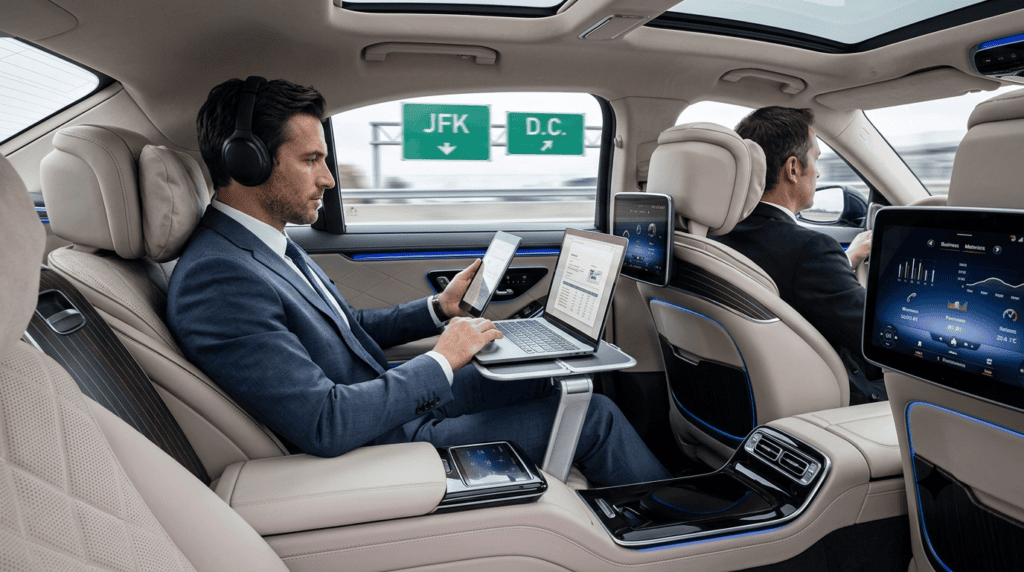
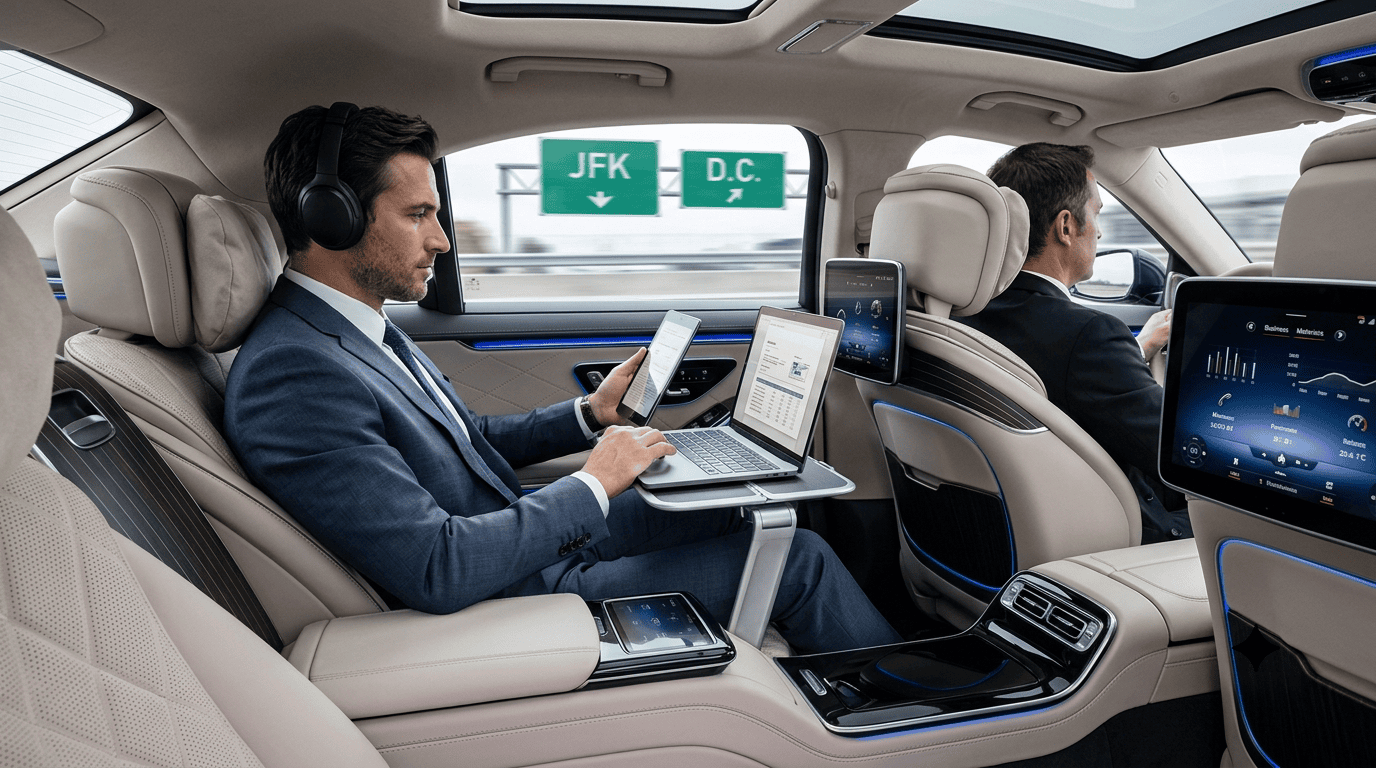
The private car provides you a direct, smooth environment—you can call easily without any distraction and also review documents as well; you do your private meeting without stressing about that other travelers have listened.

So, the trips have many transfers along the way —- from the airtrain to the LIRR and from here to roadway and then to the Baltimore Penn Station to Amtrak and then New York Penn Station these are very much distractions along the way and your call may be drop off laptop close and the entire focus is destroyed.

According to some passengers, it looks small, but for executives who schedule the trip and use the two hours by doing meetings and calls, preparations such that all these distractions cost them a lot.

The problem is not just of the travel time and cost — it’s about how much of the time is spent by doing work productively — so the direct trip gives you more chances for your work rather than the trip with many fragments and transfers along the way.

Three Layers of Accountability: Who Is Responsible When Something Goes Wrong


The one more thing is accountability: who takes your responsibility if something happens wrong. The trip option has many steps of transportation along the way. Many companies are looking forward to the trip.

The trip of JFK has the LIRR, airtrain and taxi and the baltimore have the train of amatrak at the two ends. So if any delay happens at one point, then the other company is not accountable for this. If a problem occurs at the AirTrain, then the LIRR is not responsible.

If your train reaches late at the new york airport then the taxi driver is not then the taxi driver is not accountable for the wait. You have to tackle it by yourself.

On the other hand, the private car service from Baltimore to JFK provides you with three layers of accountability in the whole trip—the experienced driver, team, dispatcher, and company support. If your flight is delayed, our monitoring system manages it according to the pickup, and the passengers don’t do this alone; the whole company system supports them. Rather, you have to contact several companies at the same time—this provides you direct contact on the trip.

The Total Trip Cost Model, Both Corridors


This model focuses on the full trip cost, not only on the price of the ticket. The honest comparison must have counted all the factors —- like, cost of transfers, waiting, tips, and the time that they use for working.

In these two routes the trip cost must be separate. The reason is the whole trip is different—the main purpose is to measure the full cost of the entire trip, not only the price of the ticket.

JFK corridor (illustrative structure—figures to be confirmed)


Private car service
AirTrain + LIRR/subway + local transit
Base fare
Executive Sedan/SUV Transfer from the JFK to Midtown Manhattan, it has a cost of $145 by adding tolls and gratuity.
AirTrain ~$8.75 + LIRR ~$8–17 depending on time of day, or subway ~$3
Number of legs
1
2–3 (AirTrain, LIRR/subway, possible local transfer)
Flight delay handling
Automatic Re-Dispatch — Your time of pickup is managed depending on your flight arrival time. By using a tail number, they monitor your flight and manage it according to arrivals and without any delays or charges.
None — traveler must reassess in real time
Usable work time
Full trip
Interrupted at each transfer
Luggage handling
Door to door
Carried through transfers and stairs/escalators

Baltimore corridor (illustrative structure—figures to be confirmed)


Private car service
Amtrak (Acela/Northeast Regional) + ground transit on both ends
Base fare
Corridor Rate—From New York City to Central Baltimore, the one direct car costs about $650.
Roughly $40–$280+ depending on class and time, plus ground transit on both ends
Trip time, station-to-station only
N/A
~2h15m–3h
Trip time including both ends
Dispatch time—travelling from the Manhattan office to the Baltimore destination through 1-95 requires a time of 3 hours 30 minutes based on the traffic.
Adds time to reach Baltimore Penn Station and time from NY Penn/Moynihan to final destination
Number of legs
1
3+ when both ends are counted
Usable work time
Full trip
High during the rail segment itself; interrupted at both ends

The purpose is not that one option is best—it’s about where each option has some benefits. For you, Amtrak can be a better option when you only see the ticket price and time. But when counting all the hassles along the way of waiting, transfers, no productivity. Then the option of a private car is more beneficial.

So, the necessary point is to focus on the full trip —- not only the ticket price.

Real Cost-Per-Minute Executive Valuation ($/Minute Model)


While doing a comparison of transportation, don’t just count the ticket price; also add how much the passenger time is worth by doing work.

Fully Loaded Executive Time Model


The executives model looks at the full cost of the trip and how much time is spent in waiting, traveling, and transfers.

Each minute of the executives costs the company—that is the main purpose.

Base Executive Annual Compensation:
$1,200,000 / year
Fully Loaded Cost (Benefits, Equity, Overhead x1.5):
$1,800,000 / year
Effective Working Hours (2,000 hrs/yr):
$900.00 / hour
Executive Time Value per Minute:
$15.00 / minute

Time Value Lost to Micro-Interruptions


According to the research, the brain, after facing some distractions—picking up the bags, changing places, or passing from the ticket gates—requires about 23 minutes and 15 seconds to come back to focus on the work.

So, the small distractions can easily lose your entire focus in productive time.

Transport Mode
Total Elapsed Time
Micro-Task Work Blocks
Disruptions / Transfers
Usable Deep Work Time
Executive Valuation Rate
Total Value Impact
Amtrak / Multi-Modal Train
120 Minutes
15 min, 10 min, 25 min (Triggering 23m Reset Periods)
Transfer, Boarding, Egress (Lost Time)
0 Minutes
$15.00 / min
-$1,800.00 (Lost Value)
Private Car Service
70 Minutes
65 Minutes Uninterrupted Deep Work
Door Close to Arrival (Zero Disruptions)
65 Minutes
$15.00 / min
+$975.00 (Recaptured Value)

Comparative Financial Analysis


When you avoid the hassles and distractions and have more focus of work in the entire journey, the private car saves about $1,200–$1,400 of one in the total.

So, at the start the car has a higher price, but after removing all of your extra steps and hassles, it becomes more worth it.

Cost Factor
Amtrak Acela / Rail Option (JFK / Baltimore)
Chauffeured Private Car Service
Out-of-Pocket Fare / Rate
$180 – $350 (First Class + Taxi Connects)
$250 – $450 (Flat Corporate Rate)
Door-to-Door Duration
110 – 140 Minutes
55 – 75 Minutes
Lost Productivity Minutes
~110 Minutes (Fragmented)
~10 Minutes (Boarding/Egress)
Cost of Lost Time ($15/min)
$1,650.00
$150.00
True Economic Cost
$1,830.00 – $2,000.00
$400.00 – $600.00

Where Amtrak Wins Outright


This point is fundamental because comparison is always because of honesty—and also add the Amtrak option as a better choice.

Amtrak wins outright when:

  1. When your trip is from one station to another —- if your Baltimore office and meeting in New York are just a short walk from the train station, then it’s a very minor reason to pay for a private car for 2 hours and 25 minutes of travel.
  2. When you are a solo traveler and have less luggage, you can easily work at a desk with better wifi or a power outlet instead of a car.

So, in these cases Amtrak trains can be a better choice.

The budget is also a main factor. Acela trains have more charges, and the train is less costly than a private car on the Baltimore corridor because the train is fast and reliable. Some of the passengers have their own choice. They choose the train; they don’t need to drive, and they feel the train is better and more productive instead of a car.

But this is different from the JFK route because JFK doesn’t have a train service that is direct towards Manhattan. Both these options are better, but the reasons are different—Amtrak is less costly and fast, but the private car provides you direct service without any distractions or transfers.

Putting It Together: The Fixed-Endpoint Problem as the Real Throughline


The problem is the same in the two routes—there is no direct train to JFK, and by doing measurements in between, many transportation options. Initially Baltimore has a better train, but when looking at the whole trip from pickup/beginning to final location, all the things are the same as JFK, and it has a trip of many transfers.

The fixed endpoint problem — tells that the train is compared and measured in just stations, not the whole trip from beginning to final. The endpoint problem is not in the private car—it begins from where you are and where you want to go rather than multiple transfers along the way. It has a direct one trip without delays and waiting.

A Worked Morning: JFK to Midtown


By using real examples, it focuses on the fixed endpoints—because the additional time is added in every step. The traveler arrives at 7:40 a.m.; all the luggage takes 20–30 minutes in the morning, and it can be long if delays happen. If a passenger did everything at 8:10 a.m., then the next move is from JFK to Manhattan.

In the AirTrain and LIRR, it means walking in the transfers and waiting a lot for the next train, then moving to the Jamaica station and then to the LIRR, then waiting again and then taking the train to Penn Station/Moynihan.

The only air train and LIRR take the time of 35–50 minutes—and there is no additional time from the stations to the final destination. In Midtown the trip adds 10–20 minutes of walking.

For the passengers who clear the checking process at 8:10 a.m., they arrive at the downtown office at 9:00–9:30 a.m., so for this reason, they do not have enough time for the meeting at 9:30 a.m.

And most of their time in travel is difficult to use for work because they are moving from place to place, waiting a lot, and handling their luggage.

And in the private car once you sit—then your continuous journey starts. The business executives sit and start their work, make their 9:30 a.m. call, and also review their documents easily. They also have to be planning for their meeting instead of moving from the transfers.

The time of “35 to 50 minutes” in the JFK time of travel is correct but does not show the full travel time. The reason is the entire trip has many transfers along the way —- this time is only for moving from one train to another, not for everything.

A worked morning: Baltimore to a client site in Midtown


Looking at the trip to Baltimore with the same idea with more correct timing. A train can be a suitable option if a traveler moves from Baltimore Penn Station to a place near New York Penn Station or Moynihan. After that, they take the Acela train and reach it in 2 hours and 15 minutes.

And then you just have to do some walking to arrive at your final location.

When your trip is not near it, like in the Midtown East or near Grand Central— when you arrive at the station you have a walk of 15–20 minutes from the rush streets and taxi. It’s the same as in Baltimore until your destination is about 5 minutes close to the office. You may have to take the rideshare or taxi, dragging your bags, and it takes more time to reach the train.

So this has the three parts—from Baltimore station, take the train and then move from New York to the final location. Due to these additional steps, the whole trip takes the time of 3.5 to 4 hours plus—and it’s not meant that the train is not fast; it means the train has no direct door-to-door trip towards your final location.

Here is the whole travel time while moving from and towards the stations:

Train Route — In the office it requires 20 minutes and a waiting time of 15 minutes and 2 hours and 18 minutes on the Acela to arrive at Midtown, which requires 22 minutes—so totally 3 hours 15 minutes.

Dispatched Car—it requires 3 hours 5 minutes in a continuous trip from pickup to final destination. The train is also fast, but the extra steps in the journey make the car fast and strong.

The Continuity Argument, extended: What Actually Happens on Each Leg


In this it’s important to know about what the “distraction” actually means. While comparing the continuity with this 2 hours and 15 minutes, it looks like a small advantage—but it’s good and necessary and has more time for work without transfers.

In the AirTrain, doing the call is very difficult here because the WiFi connection drops off and a noise behind you and the passengers are managing their bags and moving here and there.

In the LIRR, the singles and seats are good, but trip time is short; that is why many passengers don’t make long calls about meetings; they only do the emails and document reviews.

In Amtrak, it’s a better point for getting your work done. It has WiFi, power outlets at your table, and 2 hours of time, mostly without any interruption.

The trip by train has many parts, but the Amtrak train can be a better option for your work at the same time as the car.

The main hectic is present at the start and end of the trip — the time of 15 minutes before the train starts you have to move from the different areas of finding the platforms so here you are not do you work and when you land at the airport the 20 minutes are also required you search the gate and taking taxi managing the luggage from busy spots.

The private car didn’t finish the 2 hours of ride. It saves your time from start to finish, and the passengers in the car are just traveling, and the passenger in the train is passing on the extra steps. Each year if someone takes the bus trip – so these additional steps add a lot of time.

The broadroom continuity index does not mean that a car is always better—it focuses on how much of your time is spent on the work. The tips that have more additional steps here, the work percentage is very low despite one part of the trip being good.

Decision guide:


The business travelers ask these questions.

Is the starting and ending point farthest from the station?

Because of extra steps in waiting and walking, the benefits of trains are less.

Do I have enough time on the trip for making the calls, reading documents, and working without any distractions?

Yes! The private car provides you more valuable work hours without any transfers.

Can I travel with bags and work stuff that can cause difficulty in train transfers?

Yes, you can carry it, but it provides ease in the car.

Just saving money is more valuable than saving time?

If your main purpose is to save money then your location is near train stations and on the Baltimore train can be a better option.

How important is it when a company is accountable for your entire trip rather than just one part?

So, the three layers of accountability tell that — not every part of the trip is bad. The point is when many companies manage your trip, not the one company for the whole trip.

A train can be a better choice if you are traveling alone with other very light luggage—and your location is near the Baltimore Penn Station to the Moynihan Train Hall.

The private car is the best option when you have an important meeting after arriving at JFK—and the location is far from the stations.

The reason a car is the best choice is not because it’s fast—because it provides you a direct and continuous trip, everything is managed easily, and one company is responsible for the whole journey from beginning to finish.

The two executives revisited:


When you land at JFK, they don’t just have a train as their option —- their opinion is in between a train and a car, so the terminal gap shows that the train guides don’t add the full travel time; they only add the 35–50 minutes of time.

And a traveler who arrives at the acela at Baltimore penn station has the fast train choice — so the train can be a better choice based on how much their trip is near the station and many of the Baltimore trips are not only 5 minutes of walk from their actual destination.

So, none of this tells you that the — car is better than the trains. It means here that train turntables only show the time in two stations between – need to be looked at the entire trip for figuring out which option is better from where they begin and end.

The private car takes your trip in a continuous way—from start to end—and this is the main benefit talked about.

FAQs: Why Executives Choose Private Cars from JFK to Baltimore Over Amtrak

How much does a private car cost from JFK to Baltimore?

The private cars have the cost of $300–$600 for one trip—and the final price is on the basis of number of passengers and time of travel.

What are the private transportation options provided from JFK to Baltimore?

Passengers can choose many travel options like taxis/rideshares, trains, and private cars. Train travel has many transfers along the way to reach the final destination, and taxis and ride shares can also provide another adaptable option—but the private car provides direct, continuous door-to-door travel without any transfers.

Is there an Amtrak train available from JFK Airport to Baltimore?

There is no direct train provided by Amtrak—if you want to take the first, you have to take it from Baltimore Penn Station to New York Penn Station, and then you also require some more transportation—the LIRR or AirTrain—to reach your destination.

Is there any transportation option like a fast train or private car that travels from Baltimore towards JFK?

Yes! Both of these are available. The Acela train is a fast train, but it doesn’t have a direct train to JFK Airport—after arriving at New York, you may require one more form of transportation to get to JFK.

But a private car can take you door-to-door travel without any transfers—from Baltimore to JFK.

What is the most suggested transportation from Baltimore, MD, to NYC's JFK Airport?

A private car is the easiest option for traveling from Baltimore, MD, to JFK. It provides you direct door-to-door service—you don’t need to change trains or extra transportation along the way. This makes your journey simpler and more comfortable, so you don’t need to worry about your luggage.

Facebook
Twitter
Pinterest
Reddit

Table of contents
25mn read

Scroll to Top