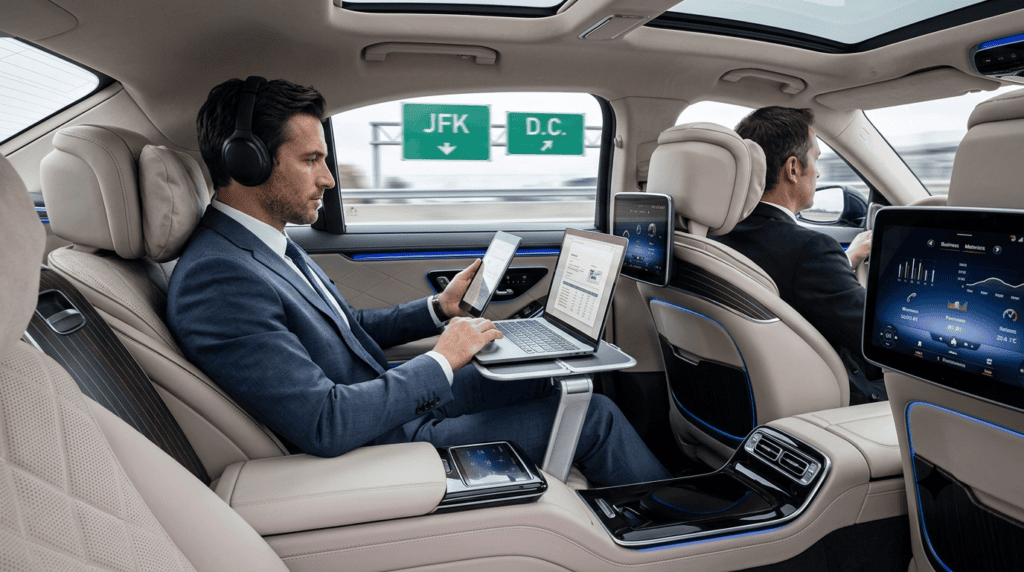
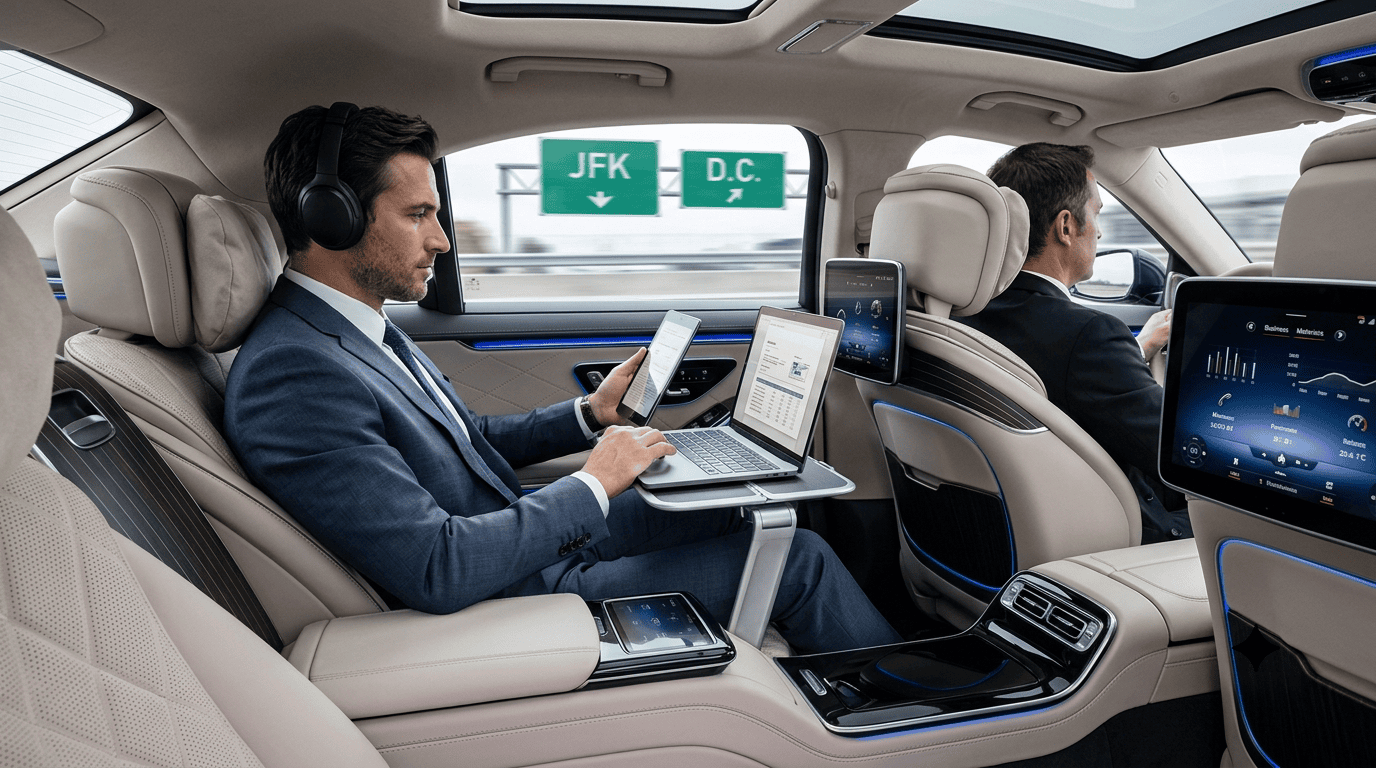
Skip the airport stress. Book a premium executive car service from JFK to D.C. and turn 4 billable hours of transit into an uninterrupted workspace.
Many of the passengers were flying between New York and Washington, DC. They know about the particular frustration of that time. You are standing in the long line for TSA (Transportation Security Administration) PreCheck at JFK Airport in New York, and your meeting starts within three hours. The flight takes a maximum of 50 minutes, but the remaining 3 hours and 10 minutes spent in the airport security lines are completely wasted.
If you are moving from country to country, route flights are the better option at that time. But moving from JFK to D.C is not a better option at that time. But with a private chauffeur, it takes 4 hours door-to-door; here, you don’t have to deal with any extra hassle or waste time.
In a private car service JFK to Washington DC, you can do your work in a calm, continuous environment where your real work actually gets done.
The Operational Evidence: Direct Comparison
Dispatchers compare a private car (with a chauffeur) vs a commercial flight vs Amtrak Acela from John F. Kennedy International Airport to a company headquarters on K Street in Washington, D.C.
We’re looking at 3 main things:
How executive feels physically during trip (comfort, stress, and tiredness)
How executive works in practice (ease, time, and reliability)
How much executive costs
The table compares what an operational reality trip actually looks like door to door, and step by step.
Transit Metric
Commercial Shuttle Flight(JFK → D.C)
Amtrak Acela (JFK → Penn Station → Union Station)
Executive Mobile Suite (JFK Door-to-Door via I-95)
Gross Door-to-Door Time
4.5 – 5.5 Hours
4.5 – 5.0 Hours
4.0 – 4.5 Hours (Direct Corridor)
Environmental Transitions
7 – 9 Discrete Transitions
4 – 5 Discrete Transitions
1 Single Transition (Curb to Door)
Max Continuous Work Block
35 – 45 Minutes
90 – 110 Minutes(Interrupted by stops)
240 Consecutive Minutes (4.0 Hours)
Data Security & Privacy
Zero Privacy (Public TSA, open seating)
Low Privacy (Quiet car, shared seating)
100% Encrypted & Private Compartment
Voice Communications
Impossible / Restricted
Restricted (Hallway/Vestibule only)
Full Confidentiality (Acoustic Partition)
Network Reliability
Intermittent (Airborne Wi-Fi dropouts)
Unreliable (Cellular dead zones in tunnels)
High-Availability (Bonded Dual 5G Antennas)
Usable Billable Hours
~0.75 Hours
~2.0 Hours
4.0 Hours
Cognitive Energy Level on Arrival
Depleted (High sensory load)
Moderate (Static fatigue)
Peak / Recharged (Deep Flow maintained)
Deconstructing the Amtrak Acela Myth
Many travelers say about the Acela’s the professional, best, and top train for executives on the Northeast Corridor.
But the Amtrak Acela train isn’t actually a convenient option for business travelers who are traveling from JFK Airport.
Before traveling on the Amtrak Acela train, business travelers’ve a hard 1st step. They must go from JFK Airport to Penn Station, NYC or Moynihan Train Hall, NYC in Manhattan.
Taking the train, then you must switch between the LIRR train, airport shuttles, or an expensive taxi, and drive through bad, or heavy Manhattan traffic. Taking a trip through busy, and crowded train stations wastes your 60 — 90 minutes of stressful and tiring travel before your actual train trip even starts.
Once, when executives get on the Amtrak Acela train, many things about the environment on the train seriously slow down your productivity.
Voice Privacy Impossibility
In the open coach and quiet car the M&A attorney, corporate board and financial advisor cannot make their important business meetings. For making phone calls they have to stand in noisy, disturbed environments in train cars and the call quality is very bad. On the other hand it’s also very uncomfortable for them to stand here for a long time to make a call.
Visual Privacy Risks
In this area your laptop screen is easily seen by travelers and other people. The private protectors of the screen can minimize this problem but it doesn’t stop the people from seeing your important information like unannounced corporate earnings and regulatory filings.
Internet Connection Problems
Amtrak doesn’t use the advanced network system; rather they rely only on commercial cellular networks for Wifi. the wifi connections can be weak and broken at — when the train travels from the rural areas in Maryland and Delaware , and rail tunnels, and your VPNs can also disconnect and all the applications that are cloud based don’t work.
Frequent Interruptions at Stations
The stops along the way in Newark, Trenton, Philadelphia, Wilmington, and Baltimore here the travelers move around because of announcements and boarding and lighting changes as well. These all make it hard for business executives to properly focus on their work — and their focus breaks in every 25 — 35minutes.
How to Measure the True Cost of Executive Travel
Business travel does not mean it’s a waste of money — choosing reliable transportation saves your company money.
Why Interruptions Cost So Much
Why interruption costs so much travelers gets distributed when they do this all— like walking in the airport through security lines and gates. It required 23 minutes to again properly focus. If executives travel from JFK, NY to Washington D.C on flight there time is worth about $1,200 an hour.
The 8 interruptions take their time of 3.1 hours of focused time.
Standing in the line and or travel without being able to do work wastes their 3.75 hours.
Result: The company lost about 6.85 hours which cost $8,220 in the loss of productivity.
Comparison: When executives travel with a private car service JFK to D.C, it has only one interruption (Getting in the private car service JFK New York) and no waste of time, it turns all your time into full productivity.
Travel Real Value (Door-to-Door ROI Equation)
To understand if a travel option is useful for a trip. so don’t just look at the ticket price, look at the total cost of wasted time.
Formula:
Net Value = Work Hours x Hourly Rate – Ticket Cost + Tiredness Cost
Short trips = Drive: Every passenger, or executive chooses the road trip depending on the short distance. Nobody thinks about flying if they travel from New York to Philadelphia, because it only takes about 2 hours.
Long trips = Fly: However, flying isn’t a good option for long distances if you travel from New York to Chicago for a 9 am meeting.
But if you travel, it is in the middle because it takes about 4 hours from JFK to Washington DC by car. It means travellers compare their total time rather than the time they actually worked. This is called the Threshold Distance Calculation: where you don’t pick how we travel; you start picking and comparing your options. Transfer from JFK to Philadelphia requires no debate, but New York JFK Airport to Washington D.C. requires talking about.
That is why, many companies like Netic Limo don’t make any claims; we promise to “beat the airlines”.
Analyzing Executive Travel: Time per Dispatcher
Our dispatcher logs show that the trip from JFK to D.C,
Normal Trip: Requires about 4 hours and 35 minutes.
Late night (no traffic): But the fastest one is about 4 hours late at night with no traffic.
Heavy Traffic: If the traffic is very heavy, then it requires 5 hours and 15 minutes.
By comparing the driving to the door-to-door. By adding every step towards the airport, to the security, and boarding and then waiting at the gate, and then taking the transfer from Dulles, or Reagan into the city.
When you start counting all these steps, the time between the flight and the drive is the same, but here the main point is productivity and how you use your time during your trip.
However, the Bureau of Transportation Statistics (BTS) and the FAA report that the flight time is about 1 hour and 25 minutes, and when you add taxi delays at JFK and airport security time, the total ends up being 3.5 to 4.5 hours.
The purpose of this comparison isn’t about driving, and isn’t to prove which type of transport service’s better than another. The time is actually the same. The main factor is how productive you are with your time.
Measuring Travel by Focus, Not Minutes
Most people measure their travel by speed. But here, the boardroom continuity tells a different story from how often your focus gets dropped by interruptions. It’s about the interruptions, not the minutes.
When a Business executive takes their flight, and their focus isn’t broken by how long the trip takes time — it’s about constant distractions. The distractions that ruin their focus are in between boarding, security checks, takeoff, and not having privacy.
By looking they take a few minutes but they break your complete focus. But a 4 hour time of JFK to Washington DC drive is the same as the flight but it provides you a deep, uninterrupted focus time of your work. drive
This idea relates to the “Rolling office,” where the car serves as the entire office, and you can work productively instead of just waiting at your destination. And the 4-hour billable board is a complete focus of work rather than just a boring productive time.
99.98% Reliable: High-Speed Internet Executives Can Trust
Our drivers logs show that 99.98% of the ride internet/hotspot is fast and the most reliable, verified by independent telematics logging. And this is an important point because it proves that you work well here. But if connections drop at some points on I-95, it’s clearly stated, not hidden. People trust this idea when it accurately reflects their limits.
Measuring Trip Productivity: The Three-Task Model
Most of the business executives don’t judge their trip by “how much time it takes?” they measure “what work they actually did” during the trip in a productive manner.
And this is what we called a Three-Call Capacity Model. It judges how many uninterrupted tasks you have done in your entire trip. Like,
Making their phone calls
Answered e-mails
Review their documents
Are you done with your work without any distractions?
A four-hour trip doesn’t mean you focus on only one task; it’s about how it naturally divides into 3 distinct parts.
Part 1 (High priority): The part 1 is about your phone calls, projects, or major tasks.
Part 2 (Medium priority): The part 2 covers easier tasks, like checking emails and reviewing the documents.
Part 3 (Preparation): The part 3 is about winding up all of the work and getting ready for the upcoming meeting, checking notes, and practicing points.
The problem with Airplane flights: If you compare your work on a flight, it will fall apart: you should start a call before boarding, and it will not work once you are on the plane. You try to work in flight, but the Wifi connection is unreliable. After landing, you stand in a long line instead of making an important call.
Maximizing Focus: How the Three-Zone Transit Model Adapts to Travel Time
When you work during a trip, time changes. But on short day trips, it will get constricted, and on the long days, about 4 hours of work time will expand. This Three-Zone Transit Model makes you more focused.
The Departure Zone (First Part): At the start, you settle in for fifteen (15) minutes, make some initial calls, and assume the vehicle is a workplace
The Middle Work Zone (Main Part): Here the route is longer and makes a big difference. The shorter trip gives you about forty-five (45) minutes of focus. But travelling from JFK to D.C. gives you the proper 2 uninterrupted hours.
The Approach Zone (Final Part): The final 45 to 60 minutes are about the arrival-at-a-destination period, when passengers stop working, get ready for the meeting, pack their laptops, and review everything, and their mindset shifts to “I am in arrival”.
The 2-hour trip to Philadelphia here is not too long to naturally shift their mindset. On the 4-hour trip to Washington, D.C., the long travel time makes the final destination more useful. It gives you really focused work time to complete all the tasks.
Ground- level Authenticity: What the Route Requires
Nothing works until your driver knows the route fully. Any typical knowledge that does not show on your GPS app. Avoiding these traffic mistakes. Because traffic slows at these three major points near Baltimore, Wilmington, and the Delaware Memorial Bridge.
And an experienced driver knows about these mistakes/jams at departure time and makes your ride very calm and smooth for 4 hours.
Departure optimal 1-95 highway
Tuesday – Thursday (Mid-Week)
Early Morning: In the early morning, go before 6:30 am to pass the morning traffic at Baltimore and Wilmington.
Mid-Day: If you want a smooth trip between morning and evening traffic jams. Drive between 10:00 am and 1:30 pm.
Fridays (Weekend Traffic):
Very Early Morning: In the very early morning, go before 6:00 am to beat both commuters and travellers on weekends.
Late Evening: In the evening, after 7:30 pm, wait because traffic at the Delaware Memorial Bridge takes time to clear.
Mondays:
Late Morning / Early Afternoon: To avoid heavy traffic and morning road work, drive between 10:30 am and 2:00 pm.
The diplomatic areas, and roads might be closed near the Capitol, K Street, and embassies due to police security. GPS apps like Google Map don’t usually warn you quickly about these sudden road blockages. But an experienced, skilled, and local driver who knows the local area gets you where you want to go without any traffic blockages.
Confidentiality as protocol, not marketing
Our clients (Executives) freely discuss the M&A terms, government contracts, and private plans. Most of our passengers use our vehicle to make their private calls, just like in the office. The car serves as a fully private workspace. Passengers need trust that their meetings and discussions remain in the car. Our drivers follow complete rules, not just promises about privacy.
All information that covers the entire trip—such as phone calls, documents, schedules, and passenger details—is strictly confidential and secure. If the passengers do not want any privacy. These rules still apply to all rides.
Drivers are not allowed to share any information with anyone, such as family or on social media. This rule applies for the driver working with Netic Limo or afterwards as well.
Driver Vetting Policy for Clients
Here are our top drivers who work for premium passengers.
Minimum Commercial Experience:8+ years in the commercial chauffeur experience who are well-trained and know the routes exactly.
Background Check: Before taking these trips, drivers check the local criminal history, license in detail, and FBI fingerprint verification by our senior dispatcher and chauffeurs.
Discretion & Privacy: For every passenger to travel smoothly and have confident conversations, drivers must sign legal non-disclosure agreements (NDAs).
The Honest Caveat
The 4-hour ride as a boardroom isn’t the right option for every trip. If you prefer working in short intervals rather than continuous trips, you can choose a flying option here. At the 1-95 construction, or bad weather, the driving can be uncertain. The purpose isn’t to agree with you; it tells you that the 4 hours in a private car can be more productive than the flight, so you can do it before booking.
The guidelines provided here are based on practical steps from dispatch data and real GPS records, and also draw on experienced drivers who know the 200 miles of the routes.
FAQ’s (The 4-Hour Billable Boardroom: How Executives Turn JFK-to-D.C. Transit into Uninterrupted Workspace)
Why should you choose an executive car service?
In private car service, you can do your work easily – make important calls, reply emails, and be comfortable on an entire 4 hour smooth ride.
The chauffeur tracks my flight for my 4-Hour Billable transfer?
Yes! Your flight is monitored for my 4-hour billable transfer and if any delays occur the time is managed and adjusted according to this.
For which JFK to D.C Car Service is more reliable?
This is best for the business travelers, executives and passengers who value the comfort, save of time, and most important productivity in their trip.
How much time is required for the trip from JFK to Washington D.C?
The trip takes about 4 hours, but it depends on the traffic and routes.